

The Future of Bioplastics in India: Will We Build an Industry or Just Build Plants?

India is entering an interesting period for bioplastics.

New investments are being discussed. Domestic manufacturing is expanding. Policies are being introduced. Companies are developing compostable products and brands are exploring alternatives to conventional plastic.
But there is one question the industry must answer honestly:
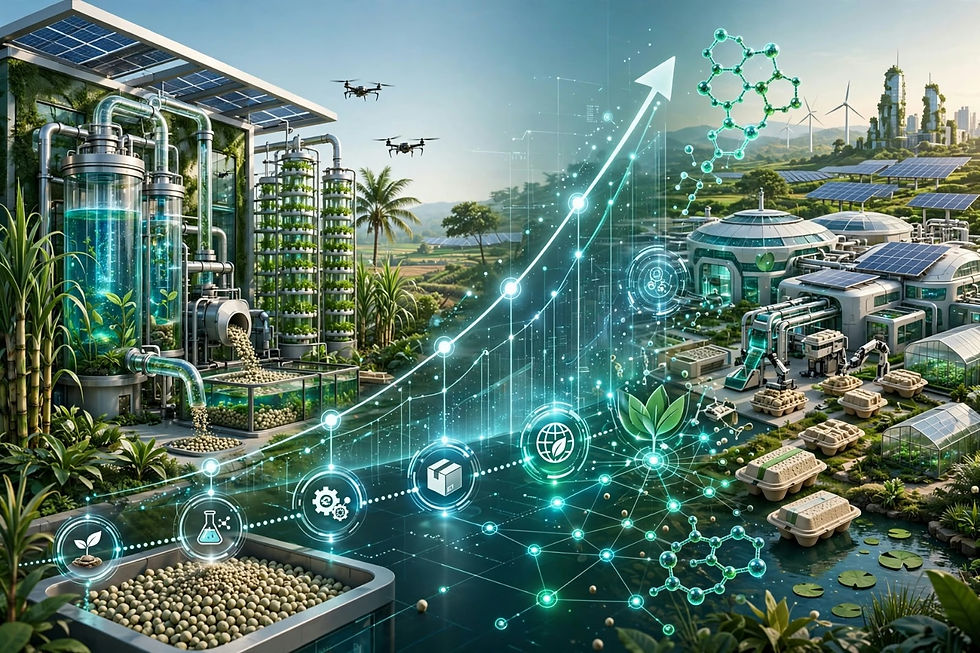
Are we building an industry, or are we simply building plants?
A plant is an asset.
An industry is an ecosystem.
The difference matters.
A real industry needs customers
A polymer plant can produce material, but that material must move through converters into products that customers actually purchase.
This requires demand forecasting, application development and long-term commercial relationships.
Without downstream demand, production capacity alone does not guarantee success.
A real industry needs converters
Converters translate polymer technology into usable products.
They need processing knowledge, equipment, technical support and reliable raw material.
The relationship between resin suppliers and converters therefore becomes critical.
A real industry needs standards
Customers need to know what they are buying.
Certification, testing and documentation help establish confidence.
Without common technical expectations, low-quality products can compete with legitimate products by making similar claims at lower prices.
A real industry needs infrastructure
Testing laboratories, research centers, waste-management facilities, composting infrastructure and skilled technical manpower all contribute to the ecosystem.
This is why policy documents that address the wider value chain are important.
Maharashtra's Bioplastics Policy 2026 is notable because it includes manufacturing, compounding, conversion, testing and R&D rather than focusing only on a finished product.
A real industry needs economics
Sustainability cannot remove the need for commercial viability.
Companies must understand their customers' price sensitivity and build products that justify their cost through performance, compliance, sustainability value or other measurable benefits.
The role of companies such as Deltora Biopolymers
Material companies have an important position in the ecosystem.
They can help develop materials, support converters, work on application requirements and participate in industry education.
But no company can create the entire market alone.
The industry needs cooperation across the value chain.
What should India focus on now?
The next stage should prioritize five areas:
Demand creation.
Testing and certification.
Converter development.
Research and technical skills.
End-of-life infrastructure.
If these areas grow alongside production capacity, new plants can become the foundation of a broader industry.
If they do not, capacity may grow faster than the market.
The opportunity is significant, but the definition of success should be broader than installed capacity.
The real success will be visible when Indian biopolymers move consistently from raw material to converter to product to customer and finally to an appropriate end-of-life pathway.
That is what an industry looks like.
India now has an opportunity to build it.
For more information about us ,visit us at https://www.thebiopolymers.com/ .
Reference context: Government of Maharashtra, Maharashtra Bioplastics Policy 2026.


Comments